
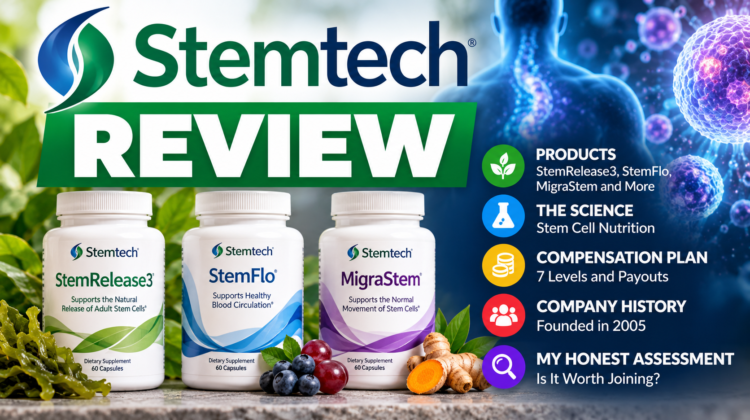
Is Stemtech a good network marketing company to join? My assessment is that Stemtech has two appealing strengths: an unusual product concept and a residual compensation plan that compares favorably with many traditional MLM plans. However, its bankruptcy history, more recent financial disclosures, and the practical challenge of building a productive customer base deserve serious consideration before you commit.
I’ve been involved in online marketing and network marketing since 2002. When I evaluate a company, I look beyond the presentation and ask three questions: Do the products have a reason to be purchased repeatedly? Does the compensation plan reward real customer volume? And can an ordinary distributor realistically generate enough qualified prospects to build the business?
This Stemtech review examines the products, the science, the compensation plan, company history, and what I believe matters most for long-term residual income. This is a research-based assessment, not a claim that I’ve joined Stemtech or personally used its supplements.
What Is Stemtech?
Stemtech is a direct-selling company founded in 2005 by Ray Carter, Howard Newman, and Christian Drapeau. It introduced the idea of stem cell nutrition to the supplement marketplace, initially with its StemEnhance product.
That phrase needs some explanation. Stemtech’s supplements do not contain stem cells, and taking them is not the same thing as receiving a medical stem-cell treatment. Instead, the company markets nutritional products intended to support the body’s natural adult stem-cell activity and related wellness functions.
As a product concept, I find that more interesting than another company selling essentially the same generic vitamins or protein powder available from dozens of competitors. But a unique concept and demonstrated clinical benefits are two different things. Both matter.
Stemtech Company History: What Happened With the Bankruptcy?
Stemtech has a history stretching back to 2005, which is meaningful in an industry where many companies come and go. But it would be misleading to describe those years as one uninterrupted period of financial stability.
In February 2017, the original Stemtech business filed for Chapter 11 bankruptcy protection. Contemporary reporting identified costly litigation as an important part of the background, including a copyright case involving unauthorized use of a photographer’s stem-cell images. A jury awarded the photographer approximately $1.6 million. The company also faced litigation involving a raw-material supplier.
At the time of the filing, reports described approximately $5.2 million in unsecured debt, $3.4 million in secured debt, and $7.5 million in assets. The original company ultimately went through Chapter 7 liquidation. In 2018, a successor business acquired Stemtech assets, including intellectual property and distribution-related assets.
So the company and brand have a long history, but the present business should not be treated as though the original corporation simply operated through that period without interruption.
Does the bankruptcy mean Stemtech is unsafe today?
Not automatically. Businesses can restructure, change ownership, and continue serving customers. What matters is understanding what happened and evaluating the company as it exists now.
There is another point prospective distributors should know: Stemtech’s 2026 SEC filings reported defaults under certain merchant cash advance financing agreements and related lender proceedings. Those disclosures do not establish that the company will fail, but they are genuine financial risks worth considering. Anyone planning to build a long-term organization should read the latest filings rather than relying only on the company’s age or promotional material.
My view: Longevity is a plus, but financial history and current financial condition matter just as much as the founding date.
What Products Does Stemtech Sell?
Stemtech’s best-known offering is its RCM system, built around three ideas: Release, Circulate, and Migrate. The company also offers other wellness and personal-care products.
StemRelease3
StemRelease3 is marketed as a nutritional product supporting the body’s natural release of adult stem cells. Its positioning builds on Stemtech’s original algae-based stem-cell nutrition concept.
StemFlo
StemFlo is positioned around circulation and antioxidant support, using botanical ingredients. In the company’s RCM approach, it represents the circulation component.
MigraStem
MigraStem is marketed as supporting the normal movement and function of the body’s existing stem cells. It completes the company’s Release, Circulate, Migrate concept.
Other Stemtech products
Stemtech has also marketed products in skincare, oral care, and pet wellness, including its Cellect One, OraStem, and StemPets lines. Product availability and formulas can change, so check current labels before purchasing.
Are Stemtech Products Really Different?
I think the product concept is above average in terms of differentiation. It gives distributors a more specific story to tell than simply claiming to have high-quality supplements.
But here’s the question I’d ask before building a business around it: Are enough customers experiencing benefits they value enough to reorder month after month?
Stem cells are an important part of human biology, and there is scientific research into the relationship between nutrition and stem-cell function. That doesn’t mean every claim made about a commercial supplement is established. Research on an ingredient, a biological marker, or a proposed mechanism isn’t automatically proof that a finished product produces meaningful health outcomes.
I would want to examine published human studies on the finished formulas, the quality and size of those studies, and the evidence for the specific benefits being advertised. Testimonials can be useful for understanding customer experience, but they don’t replace controlled research.
For the business side, product differentiation only becomes a lasting advantage when it translates into customer satisfaction, retention, and repeat purchases.
How Does the Stemtech Compensation Plan Work?
Stemtech’s Prosperity Bonus Plan is a seven-level unilevel-style plan with compression and additional bonuses. On paper, I consider the core residual payout stronger than average.
According to the company’s published plan, qualified distributors can earn 7% on monthly business-partner order volume across up to seven levels, with some higher-rank payouts increasing to 8%, 9%, or 10% on designated deeper levels. Qualifying leaders may also earn an additional 1%, 2%, or 3% Infinity Bonus.
That’s attractive compared with plans where a new distributor’s potential commission is spread across many small percentages. But the words qualified and up to are important.
Do new distributors automatically get seven levels?
No. The number of levels you qualify to receive depends on personal point volume, personally enrolled active partners, and organizational volume. The published rank chart begins with Associate, which requires 50 personal points and 100 organizational points for its first paid level. Higher ranks have progressively greater requirements to unlock additional levels.
Stemtech also uses compression rules for certain low-volume positions. Those rules affect how levels are counted for commission purposes. This is a seven-level plan, not a promise that everyone gets paid seven levels deep immediately.
What about upfront commissions?
Stemtech also offers TeamBuilder bonuses tied to qualifying enrollment packs. Its published materials describe a $50 enroller bonus and additional qualified TeamBuilder-related payouts. These can provide upfront income, but they’re distinct from the recurring commissions generated by ongoing orders.
For me, the recurring side is what deserves the most attention. A business built mainly on initial enrollment purchases can look productive for a while without developing a dependable base of customers who continue ordering.
The Small Commission Problem: Strong Percentages Still Require Volume
Here’s where I think network marketers need to look beyond the compensation chart.
Seven percent is a respectable payout. But 7% of a small monthly order is still a relatively small commission. Even a good plan requires substantial, consistent sales volume to generate meaningful residual income.
For illustration, if an order contributed $100 of commissionable volume, a 7% payout would equal $7 on a qualifying level. To generate $1,000 at that rate would require roughly 143 comparable commission-paying orders on that level, before expenses, taxes, and adjustments. That’s an illustration, not Stemtech’s actual product commission calculation or an income projection.
Now imagine trying to cover your marketing costs and living expenses while you’re still developing that customer volume. It’s easy to see why a distributor can be working hard, making progress, and still earning relatively little in the beginning.
That’s the small commission problem. It doesn’t mean Stemtech has a bad plan. It means the economics of building a residual organization can take time to work in your favor.
One approach worth understanding is how to put a separate, higher-commission marketing platform in front of the network marketing business you’re building. The idea is to potentially earn more from your own direct sales activity while continuing to develop the customer and team volume that could create backend residual income. It isn’t automatic income, and it still requires selling, but it can change the economics of the early building stage.
Before deciding how you’ll promote Stemtech—or any other MLM—it’s worth understanding the difference between relying entirely on small team commissions and having a way to earn more directly from the prospects you personally attract.

The Human Nature Problem: Not Everyone You Recruit Will Build
I’ve seen a recurring pattern over more than two decades in network marketing: people join with enthusiasm, but many never become consistent producers. Some are happy simply using the products. Others make a few attempts at recruiting and stop. A smaller group develops the habits and skills required to build a meaningful organization.
That isn’t unique to Stemtech. It’s human nature, and it affects nearly every team-based business.
Compensation presentations often show what happens when each person recruits a few people who recruit a few more. Mathematically, those examples can look fantastic. In real life, activity is uneven. Some people enroll no one. Some leave. Some become customers. Occasionally, someone becomes a strong leader.
Your income cannot be based on the assumption that everyone beneath you will duplicate your effort. If you’re fortunate enough to develop several productive leaders, the leverage can be significant. But finding and developing those people may take months or years, and there are no guarantees.
This is why I favor keeping as much of the early income-producing activity as possible in your own hands. You’re responsible for your marketing, the conversations you start, the follow-up you do, and the value you provide. You cannot control whether the people you enroll decide to build.
Why Lead Generation Matters More Than the Compensation Chart
Whether Stemtech pays 7%, 10%, or a leadership bonus, those percentages are meaningless without people purchasing products and staying active.
And where do those people come from? Leads. Qualified prospects. Real conversations. Follow-up. Relationships.
A distributor who understands how to consistently attract people interested in health, wellness, and the business opportunity has a much stronger foundation than someone who only understands how the compensation plan works.
Early in my online marketing career, I learned that generating leads is a skill you can carry from one opportunity to another. Companies change. Products change. Compensation plans change. But the ability to attract interested people and communicate with them remains valuable.
Today, I especially like marketing methods that can keep producing exposure over time, such as helpful search-based content and an email list you build and maintain. Those are assets you control more directly than the activity of your downline.
Build a contact list, not just a downline
A list of qualified prospects gives you the opportunity to educate, follow up, and build trust. Not everyone is ready to buy or join immediately. Some need weeks or months to make a decision. Others may never join, and that’s fine.
But if your entire strategy is to send a few friends a link and hope they become productive distributors, even a generous compensation plan won’t solve the underlying marketing problem.
Here’s the overlooked opportunity: when you learn to attract your own prospects consistently, you can evaluate ways to earn more from the work you’re already doing, instead of waiting for a large downline to become productive. A front-end offer with a higher direct commission can complement a longer-term residual strategy, provided the offer is genuinely useful and the economics make sense.
That distinction—between getting paid for your own sales activity and waiting for team leverage to develop—is worth examining before you spend another year trying to make a compensation chart come to life.
Is Stemtech a Good Opportunity for Beginners?
It could be, depending on what you want from a business and how comfortable you are marketing wellness products.
I see several positives:
- A differentiated product story: The stem-cell nutrition positioning is more distinctive than many generic supplement offerings.
- A straightforward core residual plan: Seven percent across up to seven qualified levels is appealing.
- Multiple ways to earn: The plan includes customer-related income, enrollment bonuses, recurring team commissions, and leadership incentives.
- A long-standing brand: Stemtech’s history goes back to 2005, although the ownership and bankruptcy history must be understood.
I also see several cautions:
- Product claims require scrutiny: An interesting scientific concept is not proof that every advertised benefit is clinically established.
- Commissions depend on qualification: The seven-level opportunity isn’t the same as seven levels of guaranteed pay.
- Retention matters: Long-term income requires customers and business partners who keep ordering.
- Financial risk is real: The bankruptcy history and more recent financing defaults deserve attention.
- Marketing skills still matter: A good product and a good plan won’t create leads by themselves.
Can You Make Residual Income With Stemtech?
Yes, Stemtech’s compensation plan offers a mechanism for recurring commissions on qualifying ongoing volume. Whether you personally earn meaningful residual income depends on sales, retention, qualifications, expenses, and the actual activity in your organization.
I would not judge this opportunity by the largest checks displayed at an event. I’d want to know how many active customers and business partners are required to generate a given level of commissions, how much they reorder, and how much time and money it takes to build and maintain that volume.
It’s also important to separate gross commissions from profit. Monthly product purchases, advertising, tools, travel, and other business expenses can reduce or eliminate what remains.
If you decide Stemtech is the right company for you, you don’t necessarily need to abandon that decision to improve your financial approach. You can focus on building a real customer base while also exploring ways to generate larger commissions from your own direct efforts during the growth stage.
My Final Stemtech Review: Would I Consider It?
On product positioning and compensation-plan design, I consider Stemtech above average. The stem-cell nutrition concept is distinctive, and the seven-level Prosperity Bonus Plan offers meaningful potential for qualified distributors.
However, I would not overlook the company’s bankruptcy and restructuring, its more recent financial disclosures, or the need for stronger evidence that the finished products deliver benefits customers consistently value. Those considerations make this more than a simple yes-or-no decision.
Most importantly, I wouldn’t join Stemtech—or any network marketing company—expecting the compensation plan itself to create my income. The real work is attracting qualified prospects, developing customers, following up, and gradually finding people who want to build.
Here’s the question I’d leave you with: What if you could build the residual-income side of your business without depending entirely on small commissions while you wait for leaders to develop? There are business models that put more emphasis on direct, higher-commission sales at the front end while still allowing you to pursue longer-term recurring income. They’re not shortcuts around marketing, but they may offer a different way to get paid for the work you’re already doing.
If you’re evaluating Stemtech for the long haul, understand those numbers before you decide how to structure your marketing. It could make a meaningful difference in how you approach your first six months, your first year, and the years beyond.
Leave a Reply