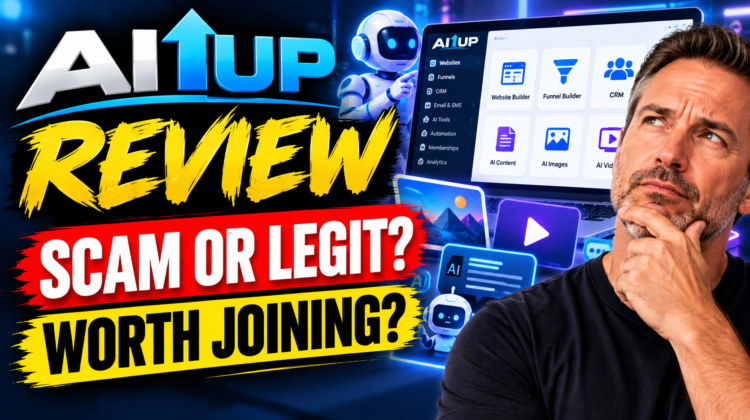
Is AI1Up legitimate, and is its 100% commission plan worth joining? AI1Up is a real AI marketing software offer built around one-time purchases and a reverse one-up affiliate compensation system. Its low entry price and broad list of tools are appealing. But if your goal is steady, recurring income, there is an important catch: a 100% commission on a one-time sale is still a one-time commission.
I’ve worked in online marketing since 2002, and I’ve learned to look beyond impressive commission percentages. I want to know what a customer actually gets, how difficult the product is to use, what happens when they need help, and whether the business model rewards long-term customer relationships or forces you to keep finding the next buyer.
Before you buy any AI marketing opportunity, consider this: would you rather earn a larger commission once, or a smaller commission that can continue each month while the customer remains subscribed? Neither model guarantees income, but that distinction can completely change how you build a business.
If you’re comparing AI tools and affiliate opportunities, it’s worth seeing what a recurring-commission platform with a ready-to-use funnel builder and ongoing marketing support looks like before you decide.
What Is AI1Up?
AI1Up is a software and affiliate-marketing opportunity centered on AI-assisted websites, sales funnels, customer management, and marketing automation. Its website promotes one-time software purchases instead of the monthly subscriptions common among hosted marketing platforms.
The software is designed to be installed on hosting you control. Depending on the level purchased and the services connected, users can work with landing pages, AI-generated content, images, video, CRM features, and marketing workflows.
That approach has genuine appeal. Some marketers prefer owning a software license and controlling their hosting instead of renting access to a hosted platform. The tradeoff is that ownership can bring additional setup and maintenance responsibilities.
Who Owns AI1Up, and When Did It Launch?
Ryan Carlson has been publicly identified in AI1Up-related promotional and review material as its creator and developer. The offer began appearing publicly in 2026, including founding-member promotions, and its packaging and pricing evolved during its early launch period.
I have not independently confirmed the full legal ownership structure or the company’s incorporation records. I would also be cautious about assuming an early launch offer represents the permanent pricing or compensation plan. Before purchasing, read the current terms on the official AI1Up website rather than relying on an older promotional video.
What Products Does AI1Up Offer?
AI1Up advertises a tiered set of software features, beginning with a core marketing system and expanding into additional AI tools and reseller capabilities. Publicly promoted individual levels have included:
- Core System — $25 one time: Website and funnel tools, CRM features, automation, and selected AI functions.
- AI Video — $50 one time: Additional video-generation capabilities.
- All AI — $100 one time: Expanded AI writing, assistant, chatbot, and related functions.
- Team & Licenses — $250 one time: Additional membership, team, and licensing capabilities.
- White Label — $750 one time: Higher-level branding and resale options.
These are advertised individual level prices, not a promise that every feature is included in the $25 entry package. Bundles, license requirements, and feature access can change. Verify the current offer before buying.
Does One-Time Pricing Mean There Are No Other Costs?
No. This is an important distinction. Even if the software license is purchased once, a self-hosted system can still require web hosting, a domain, AI API usage, email delivery, text messaging, or other third-party services. Some of those expenses are usage-based or recurring.
For example, connecting your own AI provider can be an advantage because you have flexibility over the models and services you use. But that does not mean AI usage is automatically free.
Is AI1Up Beginner-Friendly?
This is one of my biggest questions about the product. A marketer with technical experience may love the freedom of installing software on their own hosting. A beginner may hear terms such as hosting, API keys, domain settings, email integrations, and webhooks and feel overwhelmed before creating a single funnel.
That doesn’t mean AI1Up is impossible for beginners to use. It means the quality of the onboarding process matters enormously.
Here are the questions I would ask before purchasing:
- Will someone help me install the software on my hosting?
- Can I get live help when I cannot connect an AI provider or email service?
- Is support limited to technical troubleshooting, or will someone teach me how to create a funnel that actually converts?
- Are there regular live coaching sessions where I can ask marketing questions?
- Who handles updates, compatibility issues, and security for the self-hosted installation?
I have not verified that AI1Up lacks these services. It may offer tutorials, documentation, community assistance, or other support. My point is that software support and hands-on marketing coaching are not the same thing. A tool can work perfectly while the person using it still struggles to attract visitors or make sales.
How Does the AI1Up Compensation Plan Work?
AI1Up promotes a reverse one-up affiliate plan with advertised 100% commissions on qualifying sales. In a conventional simplified one-up arrangement, you receive commissions on certain direct sales, but a designated sale—often your second qualifying sale—is passed to your sponsor. After that, you can receive commissions on additional eligible sales, and you may benefit from qualifying pass-ups from people you refer.
Actual eligibility depends on the current plan rules, product level, bundle, and license qualifications. The simplified example below explains the concept; it should not be mistaken for the full official compensation document.
What Does 100% Commission Really Mean?
Suppose you sell a qualifying $100 product. A 100% commission sounds like $100 in your pocket. But in a one-up structure, not every sale you personally generate necessarily pays you. Some sales are assigned to your sponsor under the pass-up rules.
So the more useful question isn’t simply, “What percentage does the company pay?” It’s “Which sales do I actually get paid on, and how often will customers purchase again?”
My Biggest Problem With One-Up Compensation Plans
I’ll be upfront: I’ve never particularly liked one-up programs. That’s a personal preference, not an allegation that the model is illegitimate.
Here’s why. Imagine you personally introduce two people to a business. The second person turns out to be an exceptional marketer who brings in many customers and affiliates. Under a pass-up arrangement, that person or qualifying sale may be assigned to your sponsor for commission purposes.
Exactly how much future income your sponsor receives from that person’s activity depends on the specific plan. It would be inaccurate to assume every future sale from that recruit automatically goes to your sponsor. But the underlying concern is real: you can do the work of introducing a valuable person and not receive the same compensation you would under a straightforward direct-referral model.
Some marketers love pass-up plans because they can receive business from their own referrals’ activity. Others, including me, prefer a simpler arrangement: I refer a paying customer, and I receive the commission I’m qualified to earn from that customer.
Does AI1Up Pay Residual Income?
AI1Up can potentially pay leveraged commissions through its referral structure. But leveraged commissions and recurring customer commissions are two different things.
With a one-time software purchase, a customer does not automatically buy that same license again next month. To generate another commission, someone generally needs to make another qualifying purchase somewhere in the sales organization.
That means a strong month of sales does not automatically establish a similar income the following month. New purchases and ongoing activity still matter.
Of course, subscription businesses aren’t guaranteed either. Customers can cancel, payments can fail, and new customer acquisition is still important. But a subscription model at least creates the possibility of earning another commission from an existing satisfied customer without requiring that customer to make a brand-new purchasing decision every month.
AI1Up vs. a $25 Monthly Funnel Builder: Which Business Model Makes More Sense?
Here’s a comparison I think more people should make.
AI1Up advertises a $25 one-time core software level. That’s attractive for someone who primarily wants an inexpensive software license and is comfortable managing the technical setup.
But there are also hosted funnel-building platforms available for $25 per month that pay affiliates $20 per month for each referred customer who remains subscribed and qualified. That’s an 80% recurring commission on that particular product.
Consider an illustrative example. If you referred 10 customers who each kept a $25 monthly subscription active, the commission rate could produce $200 per month before expenses, cancellations, refunds, or other adjustments. That’s not a typical earnings claim or a promise of results; it simply shows how recurring commissions work.
With a one-time $25 software sale, a 100% commission would be $25 on a qualifying paid sale, and no automatic repeat commission from that purchase. You would need additional eligible sales to generate additional income.
These offers aren’t identical. One emphasizes a one-time, self-hosted license; the other emphasizes ongoing access to a hosted service. A monthly fee is a real expense to the customer. But for someone building an affiliate business, customer retention can be more valuable over time than the largest possible first-sale percentage.
And the commission percentage is only part of the equation. I also want to know whether the platform provides ready-to-use funnels, training, and actual people I can talk to when I get stuck.
If that combination sounds more useful than figuring out another software installation on your own, take a look at the alternative approach below.
Why Live Coaching Matters More Than Another AI Tool
AI has made it easier than ever to produce pages, graphics, scripts, emails, and marketing content. That’s exciting. But it hasn’t eliminated the need to understand your audience, create an offer, generate traffic, follow up, and convert leads into customers.
I’ve tried plenty of traffic methods over the years. One lesson keeps coming back: creating more content or getting more leads does not automatically mean making more sales.
For example, I previously generated hundreds of leads from short-form video marketing without getting the sales results I wanted. The problem wasn’t simply a lack of tools. I needed to look more closely at the quality of the traffic, the audience, the follow-up, and the conversion process.
That’s why I place so much value on access to ongoing training and live coaching. I want a platform where a beginner can start with a functioning funnel and then get help learning how to use it effectively, rather than being left alone with a complicated dashboard.
Some hosted marketing platforms offer live coaching multiple days per week alongside their tools. That’s a meaningful differentiator when you’re comparing products, especially if you’re not comfortable with the technical side of online marketing.
What I Like About AI1Up
- Low advertised entry price: A $25 one-time core level is accessible compared with many marketing platforms.
- Broad feature set: Funnels, CRM functions, automation, and AI capabilities are useful categories of tools for an online business.
- Self-hosting flexibility: Experienced users may appreciate greater control over their installation and infrastructure.
- Bring-your-own-AI potential: Connecting external AI services can provide flexibility instead of locking users into one provider.
- High commission percentage: Qualifying one-time sales can generate meaningful upfront commissions.
What Concerns Me About AI1Up
- One-time purchase economics: High upfront commissions do not automatically create monthly recurring income.
- Pass-up compensation: I prefer being paid directly on customers I personally refer rather than assigning certain sales to a sponsor.
- Technical setup: Self-hosted software can introduce tasks that a fully hosted platform handles for you.
- Unclear depth of live marketing support: I’d want to verify whether regular coaching is available, not just product tutorials.
- Additional operating costs: Hosting and connected AI or communication services can carry separate charges.
- Newness of the offer: A recently launched platform has less long-term history to evaluate than an established one.
Is AI1Up a Scam or Legitimate?
Based on the publicly described software and affiliate offer, I don’t see a basis to label AI1Up a scam simply because it uses a reverse one-up plan or sells software through affiliates. Those features warrant careful evaluation, not an automatic accusation.
Legitimacy and suitability are separate questions. A legitimate product can still be the wrong choice for someone who needs hands-on help or wants recurring commissions rather than one-time sales.
Before joining, confirm the current refund policy, software licensing terms, support availability, exact pass-up rules, and any additional costs. And don’t mistake screenshots of exceptional affiliate earnings for what an average beginner can expect.
My Final AI1Up Review: Is It Worth Joining?
If you’re technically comfortable, want self-hosted marketing software, and value a low one-time purchase price, AI1Up may deserve a closer look as a software product.
As an income opportunity, I’m less enthusiastic. Personally, I don’t like one-up compensation structures, and I would rather build around products customers continue paying for because they find them useful. I also want accessible, ongoing coaching that helps people learn real marketing instead of simply collecting more tools.
That doesn’t mean one-time commissions are bad. They can be valuable. It means I wouldn’t confuse a series of one-time affiliate sales with a dependable residual-income foundation.
My bottom line: Before deciding which AI marketing opportunity to promote, compare three things: what the customer pays over time, what you actually earn and retain from each referral, and how much help you get turning the tools into real marketing results.
If you’re looking for an alternative built around recurring commissions, ready-to-use marketing tools, and ongoing coaching, it’s worth comparing that model before committing your time to another one-time-sale opportunity.
AI1Up Review: Frequently Asked Questions
Is AI1Up really only $25?
The advertised core software level starts at a one-time $25 purchase. Higher levels, bundles, hosting, AI usage, and third-party services can add costs.
Does AI1Up have a monthly fee?
Its core pitch emphasizes one-time software licenses, but separate services such as hosting and AI APIs may have recurring or usage-based charges.
Do AI1Up affiliates earn 100% on every sale?
No. The advertised 100% rate applies to qualifying commissions under a reverse one-up plan. Certain sales are passed up, and qualification rules apply.
Is AI1Up passive income?
Not automatically. Its one-time license model depends on additional qualifying sales to generate additional commissions. Team activity may produce leveraged commissions, but that is not the same as guaranteed recurring subscription income.
Can beginners use AI1Up?
Possibly, but beginners should verify the installation process, required integrations, available technical support, and whether live marketing coaching is included before buying.
Affiliate disclosure: I may receive compensation if you choose an alternative platform through a link or banner on this page. This review reflects my assessment of the business models, not a guarantee of earnings. Product details and compensation terms may change; verify current terms with the companies involved.
Leave a Reply