If you’re looking for an honest Arieyl review, here’s my first impression: the company has experienced network marketing founders, an energetic brand, and a binary-style compensation plan that could be attractive to serious builders. But its wellness products don’t strike me as particularly different from many competing supplement lines, and a generous-looking commission percentage is only one part of building meaningful residual income.
I’ve been involved in network marketing and online lead generation since 2002. I’ve built organizations, evaluated compensation plans, and learned firsthand how different the numbers on a presentation can be from the realities of recruiting, retaining customers, and developing leaders.
I’m not an Arieyl distributor, and I haven’t personally used its products. This is my evaluation of the company and opportunity based on its published information and what I’ve learned over more than two decades in the industry—not a claim that I’ve personally built an Arieyl business.
Let’s look at the products, the founders, the compensation plan, and what I would want to know before committing years to building this particular opportunity.
What Is Arieyl?
Arieyl is a U.S.-based direct-selling wellness company founded by husband-and-wife network marketers Kristen and Travis Butler. The company began in November 2020 and completed its broader public launch in August 2021.
Arieyl markets a broad range of supplements and personal-care products, including minerals, mood and energy products, weight-management products, gummies, drinks, and topical formulations.
Its brand personality is bold, playful, and distinctly different from the serious, clinical presentation some supplement companies use. The company calls its representatives “Rockstars” and emphasizes community, personal expression, and lifestyle.
That may appeal to people who want a more social, energetic company culture. But when I evaluate a business opportunity, I try to look past the branding and ask a more basic question: what are customers actually buying, and why would they keep buying it?
Who Founded Arieyl?
Kristen and Travis Butler are the founders and public faces of Arieyl. Before starting their own company, they built a substantial network marketing business with My Daily Choice.
That background is relevant. They didn’t come into the industry with no experience. They knew recruiting, distributor culture, and what motivates people to join a direct-selling organization.
Arieyl’s own company story emphasizes their desire to build a business with a culture they could shape themselves. Its launch announcements also described an initial group of approximately 250 founders and launch-team members that grew substantially during prelaunch.
My reaction to this part of the story is mixed.
On one hand, I understand the appeal of experienced distributors becoming company owners. They’ve seen firsthand what distributors like, what frustrates them, and what makes a sales organization grow.
On the other hand, being an outstanding distributor and running an outstanding company are two different skills.
When I look at Arieyl, my personal impression is that this is a company built by successful network marketers who wanted to create an opportunity on their own terms. That’s an observation about the business model and founders’ history—not a claim that I know their private motivations.
And while that experience could be an advantage, it doesn’t automatically make the products exceptional or the income opportunity attractive for the average new distributor.
What Products Does Arieyl Sell?
Arieyl’s product line covers several familiar categories in the nutritional supplement and wellness market.
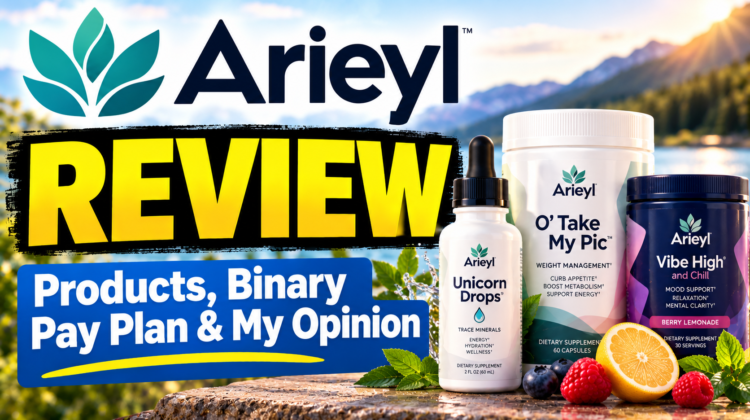
Its website features products such as Unicorn Drops, O’ Take My Pic, Vibe High and Chill, In the Mood, and other products marketed around energy, balance, beauty, weight management, and everyday wellness.
Some products use ingredients that have become popular across the broader supplement industry, including mineral blends, mushroom ingredients, nootropics, and botanical extracts.
The company describes its formulations as proprietary. That may be true of the particular blends, and I’m not suggesting they’re all identical to products sold elsewhere.
But proprietary doesn’t necessarily mean meaningfully different to the customer.
That’s the distinction I care about.
Unicorn Drops
Unicorn Drops is one of Arieyl’s recognizable products, marketed as a mineral-focused wellness supplement.
Mineral supplements are hardly new. You can find a wide variety of trace-mineral and fulvic-mineral products from traditional retailers, online supplement stores, and other network marketing companies.
So the question isn’t simply whether Arieyl has its own formula. The question is whether the ingredients, dosage, quality, price, and customer experience make it sufficiently compelling to stand out.
O’ Take My Pic and Weight-Management Products
Arieyl also markets products in the weight-management category, including O’ Take My Pic.
Weight management is an enormous consumer market. It’s also an extremely competitive one.
There are plenty of companies offering supplements marketed around appetite, metabolism, and body composition. That makes it important to look at the actual evidence for a particular formulation rather than assume a catchy product name means it produces unusual results.
Mood, Energy, Beauty, and Other Wellness Products
The company has expanded into mood, energy, beauty, and personal-care products as well.
That gives distributors several different customer conversations to have, but it also means Arieyl is competing across multiple crowded categories.
Having lots of products isn’t automatically a competitive advantage. Sometimes it gives customers more reasons to shop. Sometimes it makes it harder to communicate what the company is truly best at.
Are Arieyl Products Really Different?
Here’s where my personal evaluation probably differs from some enthusiastic Arieyl presentations.
After 24 years in network marketing, I’ve seen an awful lot of companies selling vitamins, minerals, weight-management supplements, energy products, and personal-care items.
And frankly, Arieyl strikes me as another “me-too” wellness product line.
That’s my opinion based on its product categories and positioning, not a laboratory comparison proving its formulations are equivalent to competitors.
I’m not saying the products are bad. I haven’t personally tested them, and I don’t have evidence to make that claim.
I’m saying I don’t immediately see a product that makes me stop and think, “Now that’s something consumers genuinely can’t find anywhere else.”
For me, there are two compelling ways to build a product-based business: offer extraordinary value at a competitive price, or offer a genuinely differentiated product that customers are willing to pay more for.
The uncomfortable middle ground is an ordinary-looking product proposition with a premium price largely justified by the business opportunity.
Before I built Arieyl, I’d want to compare its products with alternatives based on ingredients, actual delivered price, and repeat-purchase value. I’d also want to hear from customers who continue ordering even though they have no interest in recruiting anyone.
That tells me more about long-term sustainability than an exciting launch video.
And there is a business reason I care so much about repeat customers: a distributor organization can look impressive on paper while generating surprisingly little recurring income. Before choosing any opportunity, I would want to understand how customer purchases translate into commissions, not just how many people I could recruit.

How Does the Arieyl Compensation Plan Work?
Arieyl’s historical compensation materials describe a hybrid structure that includes a binary team commission, along with other bonuses and commissions.
In a binary, your team is organized into two legs. The volume in those legs determines how much of the team commission you may qualify to receive.
The historical plan has been described as paying from 10% up to 20% of qualifying weaker-leg volume, depending on rank and the applicable rules.
Important: I could not verify that the original 2020 binary percentages and qualifications remain unchanged in October 2026. Anyone evaluating the opportunity should obtain the latest official Arieyl compensation plan and income disclosure before relying on specific rates.
That’s not a minor detail. Compensation plans change, and the percentage alone doesn’t tell you what a distributor will actually receive.
Is a 10% Binary Commission Good?
In my experience, a 10% weaker-leg binary commission is a reasonably competitive starting point. It isn’t extraordinary, but it isn’t automatically weak either.
If a plan truly allows qualified distributors to earn 20% of eligible weaker-leg volume at higher ranks, I’d consider that a strong advertised percentage.
But I’d immediately want answers to several questions: what counts as commissionable volume, what qualifications unlock the higher percentage, whether there are payout caps, how volume carries over, and what happens if you don’t remain qualified.
Those details can make an enormous difference.
For example, imagine a hypothetical binary paying 10% on $5,000 of eligible weaker-leg volume. That would represent $500 in team commissions before other plan rules and expenses.
At 20%, the same qualifying volume would represent $1,000.
Those examples illustrate the math, not a prediction of Arieyl earnings or confirmation of its current rates.
And here’s the part I think matters most: getting $5,000 of sustained qualifying volume into your weaker leg is a very different challenge from calculating 10% of it.
Why the Binary Percentage Doesn’t Tell the Whole Story
People sometimes compare network marketing compensation plans the way they compare interest rates.
“This company pays 10%. That company pays 15%. This one pays 20%.”
But a compensation plan isn’t a savings account. You don’t deposit volume once and collect a predictable return forever.
You need actual product orders. You need customers who continue buying. You need distributors who keep working. And with a binary, you also need enough qualifying volume in the correct places.
A 20% rate on very little volume won’t create much income. A lower rate on substantial, consistent volume may produce a bigger check.
Then there are the qualifications, payout caps, customer requirements, and other details that affect the final result.
That’s why I’d never choose a company based on a commission percentage alone.
I’d want to know how much organizational activity is required to generate the monthly income I’m hoping for—and how realistic that activity is to maintain.
There’s a useful comparison in a free guide I’ve been sharing: one marketer describes having roughly 600 people in an organization and earning about $1,200 per month, then later reporting substantially more income with a much smaller team in a different model. Those are his experiences, not Arieyl results or typical-income projections. But the contrast raises a question worth considering before building any downline.
The Human Nature Problem Nobody Can Fix With a Compensation Plan
This is the part of network marketing I think people underestimate the most.
Leverage is a powerful concept. You find a few people, help them get started, and ideally they go on to build organizations of their own.
Then their activity contributes to the larger team.
On paper, the math can look incredible.
But I’ve spent more than two decades watching what happens when those charts meet human nature.
Some people join and never really get started. Others make a few calls, talk to a handful of friends, and stop when the excitement wears off.
Some people are perfectly happy buying the products but have no desire to build a business. There’s nothing wrong with that, as long as they’re genuine customers receiving value.
And some people want to build but struggle to generate leads, follow up, or stay consistent long enough to get results.
Eventually, you may find a few people who take the business seriously and develop into productive leaders. Those are the people who can create real leverage.
But finding those people can take a substantial amount of time.
That’s not a criticism of Arieyl’s distributors. It’s an observation about network marketing generally, based on my own experience.
Why “Just Find Two Who Find Two” Sounds Easier Than It Is
Binary presentations naturally lend themselves to duplication charts.
You recruit two people. They each recruit two. Then those people recruit two more.
Before long, the chart is full of names.
But what if one of your first two people never recruits anyone? What if the other recruits five people but none of them becomes a serious builder?
Now you’re the one trying to keep the organization moving.
Even when a company has strong leadership and a good training culture, you can’t make someone else do the work.
You can teach, encourage, support, and set an example. You can’t manufacture another person’s commitment.
That’s one reason I believe building meaningful residual income through a traditional downline can become a much longer project than people initially expect.
You’re Putting Part of Your Income in Other People’s Hands
There’s a tradeoff at the heart of network marketing.
The attraction is leverage: other people’s sales activity can contribute to your commissions.
The downside is that part of your income depends on activity you don’t directly control.
People quit. Customers cancel. Leaders change priorities. Families move. Jobs become demanding. Someone who looked like a future superstar may decide the business isn’t for them.
That doesn’t make the model impossible. It makes the human element an important part of the economics.
I’ve learned to be much more interested in how many customers and productive builders a business actually retains than how many names appear in a downline report.
And that brings up a question worth asking: if most of your recruits never build much of a business, how large does the organization need to become before the income is meaningful? A different way of looking at team size and payout economics can be eye-opening.
What Would It Take to Build a Large Arieyl Team?
I don’t have verified Arieyl-specific statistics showing how many people the average distributor recruits or how many remain active. I wouldn’t invent those numbers.
But I can explain the questions I’d ask.
Suppose you personally enroll 20 people. How many become regular customers? How many want to recruit? How many recruit consistently after the first few weeks? How many eventually develop customers and leaders of their own?
Those numbers are far more useful than simply knowing you sponsored 20 people.
And if you want a team of hundreds or thousands, you have to account for people leaving, stopping their orders, or no longer actively promoting the business.
That means new sales and recruiting activity often have to replace lost volume before they create real growth.
The larger the organization becomes, the more important retention, leadership, and customer satisfaction become.
For a binary specifically, I’d also want to understand how volume is distributed between the legs and how the plan handles imbalances.
Having 1,000 people somewhere in your organization doesn’t automatically mean your binary is producing substantial commissions.
What I Like About Arieyl
First, the founders have real network marketing experience. They’ve been on the distributor side of the business, and that perspective can be valuable when building a company.
Second, Arieyl has a distinctive brand personality. It isn’t trying to look exactly like every traditional supplement company, and that may help it attract a particular type of customer and distributor.
Third, I can appreciate a compensation plan that appears, historically, to offer a competitive binary payout percentage. A 10% starting rate is respectable in my opinion, and a genuinely attainable 20% rate would be attractive.
Finally, having a broad product line can give existing customers several categories to explore.
Those are legitimate positives, even though they don’t automatically persuade me to build the business.
What Concerns Me About Arieyl
My biggest product concern is differentiation.
I’m not seeing an obvious category-defining product that makes Arieyl stand out dramatically from other supplement companies selling minerals, energy products, weight-management supplements, and beauty products.
My biggest business concern is that an attractive binary percentage can distract from the hard work of building enough recurring volume to make that percentage meaningful.
And I would want the current compensation plan in front of me before relying on any specific payout or rank qualification. The historical figures are interesting, but a serious business decision needs current documents.
Finally, I would be cautious about the natural tendency to confuse a strong founder story and an enthusiastic distributor culture with proof that the average person will earn significant income.
Those are not the same thing.
Has Arieyl Faced Concerns About Earnings Claims?
Arieyl has appeared in industry discussions about the way network marketing earnings are promoted. Earlier reporting also documented a dispute between My Daily Choice and Arieyl’s founders that was subsequently settled.
That history isn’t proof that Arieyl is an illegitimate business, and I wouldn’t treat a settled dispute as a finding that every allegation was true.
More broadly, earnings claims deserve scrutiny throughout the industry. A top distributor’s income is not a reasonable forecast for someone starting from scratch.
Before joining, I’d look for a current official income disclosure, including how many distributors earn nothing, how much the median participant earns, and whether reported commissions exclude business expenses.
Without that information, I’d avoid drawing conclusions from top-earner stories or lifestyle marketing.
Is Arieyl Legit?
Arieyl is a real direct-selling company with identifiable founders, an operating website, a product catalog, and a history going back to 2020.
But “Is Arieyl legit?” isn’t the only question I’d ask.
A company can be legitimate and still be a poor fit for your budget, product preferences, marketing skills, or income goals.
I’d want to know whether customers genuinely value the products, whether the prices are competitive, whether the compensation rules are understandable, and what level of ongoing customer volume would be needed to generate a meaningful income.
I’d also ask whether I could realistically attract and retain those customers without relying entirely on recruiting new distributors.
Would I Join Arieyl Today?
Based on what I’ve reviewed, Arieyl wouldn’t immediately jump to the top of my list.
That’s not because I think the founders lack experience. Quite the opposite.
And it’s not because a 10% binary payout is bad. I think that’s a respectable advertised rate, assuming the plan actually pays it on qualifying volume under reasonable conditions.
My hesitation is that I don’t see a compelling enough product difference to make me excited about competing in another crowded supplement category.
And I know how much work it can take to build the kind of organization that produces meaningful recurring commissions.
If someone loves the products, has reviewed the current plan, and wants to build Arieyl, I wouldn’t tell them they have to abandon it. But I’d encourage them to focus on real customers, repeat orders, and productive leadership—not just the percentage on the binary chart.
My Bottom Line on Arieyl
Arieyl has experienced founders, an energetic company culture, and a historically competitive-looking binary plan.
What it doesn’t have, at least from my perspective, is an obviously differentiated product proposition that makes me want to overlook the challenges of building a large traditional network marketing organization.
And those challenges are substantial.
You can recruit dozens of people and still find yourself doing most of the work. You can build a team of hundreds and discover that the actual recurring income is less impressive than the downline count.
Or you can spend years searching for the handful of people who become serious leaders.
Leverage is powerful. But the amount of leverage you actually develop depends on real people making real sales consistently over time.
That’s why I’d spend at least as much time studying the economics of the business as I would studying its products and compensation presentation.
Before You Build a Huge Team, Look at the Math
One of the most interesting stories I’ve encountered about residual income comes from marketer Paul Hutchings.
He describes spending years building a network marketing organization of approximately 600 people while earning about $1,200 per month in residual income.
Later, he describes a different business model and a much smaller team—roughly 60 people—producing a substantially larger monthly check.
Those are Paul’s reported experiences, not Arieyl income figures, typical results, or a promise of what someone else will earn.
What interests me is the underlying lesson.
More people doesn’t automatically mean more income.
The compensation structure matters. Customer revenue matters. Qualifications matter. And perhaps most importantly, how much of the income depends on other people building a business matters.
If you’re evaluating Arieyl or any other network marketing opportunity, I think it’s worth understanding that distinction before investing years of your time.
There’s a free guide that walks through the team-size comparison, the human-nature problem, and why the math behind a residual-income model can matter more than the size of the organization.
Disclosure: I am not an Arieyl distributor and have not personally tested its products. This article combines public company information with my opinions based on more than two decades of network marketing experience. Some banners or links on this website may be affiliate promotions, and I may earn a commission if you take action through them. No income is guaranteed. Compensation terms and product details can change; verify current information with Arieyl before making a purchase or business decision.
Leave a Reply